
The best paid-search strategy does not end when someone clicks an ad.
That is where the expensive part begins.
A click is only a handoff—from a search query to an ad, from an ad to
a landing page, from a landing page to a sales process, and eventually
from a marketing expense to measurable business value. If any part of
that chain is weak, buying more traffic simply gives the weakness a
larger audience.
Digital Cheddar treats paid search as a connected growth system. We
align campaigns with business goals, track meaningful actions, shape the
customer journey, use automation deliberately, connect lead quality and
revenue back to the media, and report what the numbers actually mean.
There are fewer vanity metrics, fewer black boxes, and considerably less
ceremonial jargon.
Here is what a serious paid-search strategy looks like beyond the
click.
The Click Is a
Signal, Not the Finish Line
Clicks tell us that an ad earned enough attention to prompt action.
They do not tell us whether the visitor was qualified, found what they
needed, completed the next step, became a customer, or generated
profitable revenue.
That is why Digital Cheddar begins with a business question instead
of a platform question. We do not start with, “How many campaigns should
we launch?” We start with, “What should this investment accomplish?”
The answer might be:
- Generate qualified commercial leads
- Sell higher-margin products
- Fill appointments in specific markets
- Acquire new customers profitably
- Support a seasonal promotion
- Defend branded demand
- Enter a new category or geography
- Increase total pipeline, not merely form submissions
Once the outcome is clear, every campaign choice can be judged
against it. Without that anchor, paid search becomes a busy little
machine that produces graphs.
Strategy
Layer 1: Translate Business Economics Into Platform Goals
Advertising platforms optimize toward the signals advertisers
provide. If a company tells Google that every lead is worth the same
amount, the system has no reason to distinguish a future six-figure
customer from someone asking whether you are hiring.
A mature strategy maps business economics into campaign decisions.
Useful inputs include:
- Average order value
- Gross margin by product or service
- Lead-to-opportunity rate
- Sales close rate
- Customer lifetime value
- Repeat purchase behavior
- Capacity and geographic coverage
- Sales-cycle length
- New-customer value versus existing-customer value
These inputs help determine whether the account should optimize for
conversion volume, conversion value, a target cost per acquisition,
return on ad spend, or another objective.
Google’s Smart Bidding options include Target CPA, Target ROAS,
Maximize Conversions, and Maximize Conversion Value. Those tools use
auction-time signals to set bids, but the advertiser still decides what
success means. Powerful math cannot rescue a meaningless goal.
Strategy
Layer 2: Build a Measurement System the Algorithm Can Trust
Conversion tracking is often treated like a technical checkbox
completed before launch. It is closer to the campaign’s nervous
system.
Digital Cheddar’s philosophy is to track everything that helps
explain performance: calls, forms, chats, purchases, appointments,
downloads, and downstream sales events. But “track everything” does not
mean “optimize toward everything.” Primary conversion actions should
represent the outcomes worth buying. Secondary actions can provide
context without hijacking bidding.
The measurement plan may connect:
- Google Ads conversion actions
- Analytics events
- Call-tracking platforms
- Website forms and chat systems
- Ecommerce data
- CRM stages
- Offline conversion imports
- Custom dashboards and automated reports
Enhanced conversions can supplement existing Google Ads tags with
hashed first-party data to improve measurement accuracy, provided
implementation follows applicable privacy, consent, and customer-data
requirements. The important strategic point is broader: as browser and
privacy conditions change, first-party data and validated conversion
feedback become increasingly valuable.
You would not hire a salesperson, refuse to tell them which deals
closed, and then complain that their prospecting never improves. Do not
do the digital equivalent to your ad platform.
Strategy
Layer 3: Map Demand Instead of Worshipping Keywords
Keywords still matter, but they are one component in a system that
includes query meaning, audience context, landing-page relevance,
bidding signals, and creative assets.
Digital Cheddar organizes search demand around intent:
- What problem is the person trying to solve?
- How close are they to making a decision?
- Are they seeking a product, service, comparison, location, price, or
instruction? - Is the query relevant to what the business actually sells?
- Does the company have a credible page that answers the need?
- Is this a customer we want—and can serve well?
Search-term analysis then closes the loop. Google’s search terms
report reveals queries that triggered ads and can inform negative
keywords, new keyword themes, ad messages, and landing-page content.
This is also where paid search can improve SEO, AEO, content
strategy, and sales enablement. Real search queries expose how customers
describe their needs. Sometimes they use the carefully researched
language from your brand guidelines. Sometimes they type “big metal
thing that keeps pizza warm.” The customer remains the customer.
Strategy
Layer 4: Use Creative as a Qualification System
Search ads operate in a cramped space, but the message can still do
several jobs:
- Match the user’s intent
- Explain the offer
- Signal why the company is different
- Establish relevant proof
- Set expectations
- Invite the next action
- Discourage the wrong click
Responsive search ads give Google multiple headlines and descriptions
to combine and test. That creates more opportunities for relevance, but
it increases the need for coherent assets. Every combination should make
sense, support the offer, and avoid accidental promises.
Digital Cheddar writes variations around actual decision factors—not
filler created to occupy every available field. We test benefits, proof,
specificity, urgency, geography, risk reduction, and calls to action.
Then we study which themes produce qualified behavior after the
click.
An ad is not successful because it wins the click. It is successful
because it attracts a person the rest of the business is prepared to
convert.
Strategy
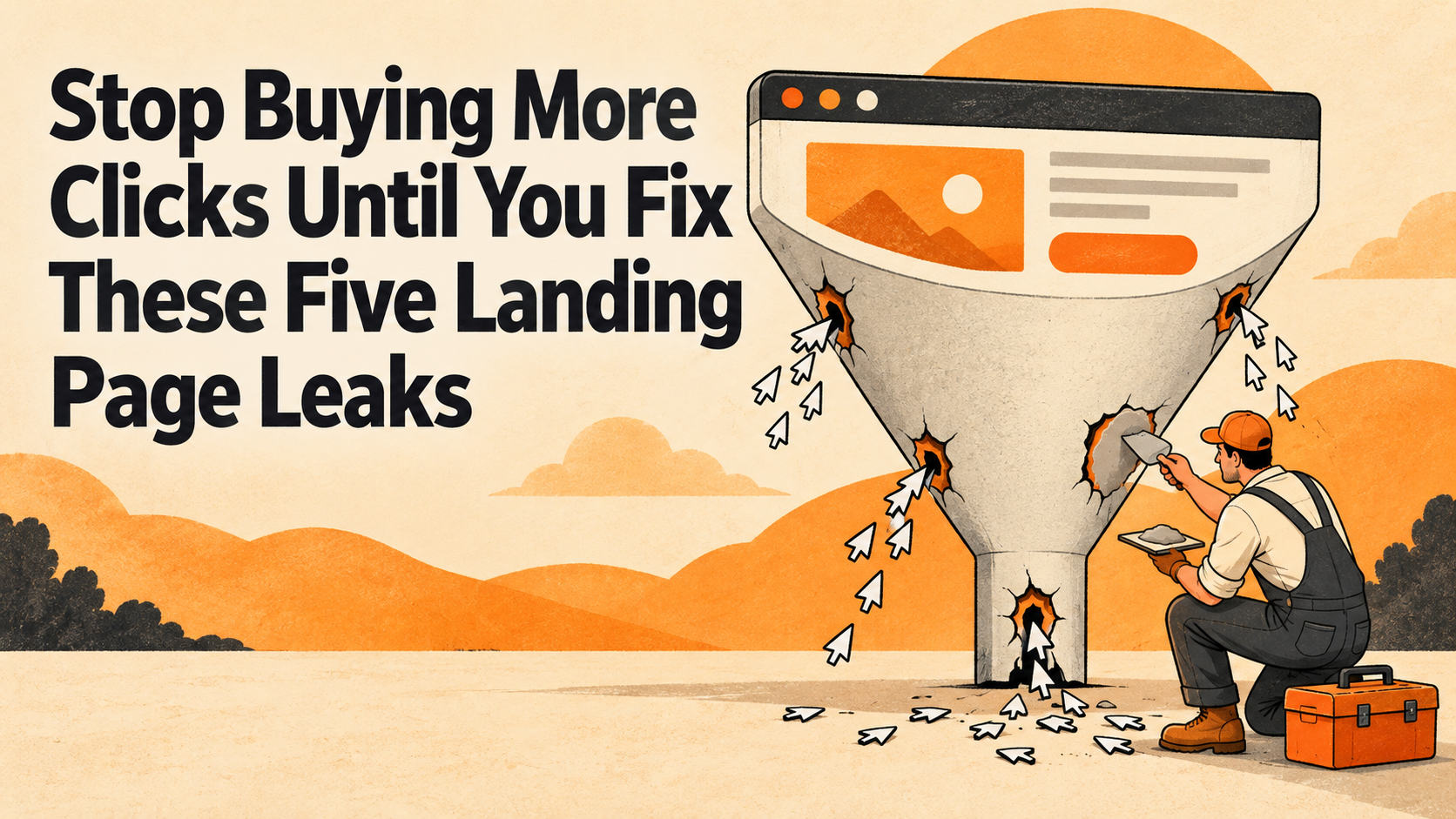
Layer 5: Treat the Landing Page as Part of the Campaign
The landing page determines whether the promise in the ad becomes a
useful experience or an awkward bait-and-switch.
Strong alignment means the page reflects the search and ad language,
answers the visitor’s immediate questions, presents credible proof, and
makes the next step clear. The page should also respect mobile users,
load quickly, and remove unnecessary friction.
Depending on the goal, Digital Cheddar evaluates:
- Headline and message match
- Offer clarity
- Service, product, and geographic relevance
- Calls to action
- Form length and usability
- Phone visibility and call tracking
- Trust signals, reviews, credentials, or case studies
- Mobile experience
- Page speed
- Confirmation-page and conversion-event accuracy
Landing-page optimization changes the economics of the campaign. When
more qualified visitors convert, the same media spend can produce more
opportunities. That is usually more interesting than celebrating a small
drop in cost per click while the website continues to repel people.
Strategy
Layer 6: Give Automation Guardrails and Good Ingredients
Google’s AI-powered bidding can evaluate auction-time context at a
scale no person can manually reproduce. It can be exceptionally useful.
It can also pursue a poorly defined goal with exceptional
efficiency.
Digital Cheddar combines automation with human direction. The
platform can decide how aggressively to bid in an auction. The
strategist decides:
- Which campaigns and goals belong together
- Which conversion actions and values are trustworthy
- Which locations and customer groups are relevant
- Which exclusions and brand protections are required
- How budget should reflect priorities and constraints
- Whether the landing page can fulfill the ad promise
- When a performance shift requires action
We also allow tests enough time to produce meaningful evidence.
Constantly resetting campaigns because someone got nervous after 36
hours teaches the system very little—except that its humans enjoy
touching settings.
Strategy
Layer 7: Connect Lead Quality Back to the Campaign
For lead-generation businesses, the platform conversion is not the
business outcome. The sales conversation is where quality becomes
visible.
Useful feedback can include:
- Was the lead qualified?
- Did the company reach the lead?
- Did the lead become an opportunity?
- What was the estimated value?
- Did the opportunity close?
- Why was it lost?
- Which services, products, or locations produced the strongest
customers?
When that information flows back into campaign analysis—and, where
appropriate, offline conversion measurement—the account can optimize
toward quality instead of the easiest form completion.
This also requires operational honesty. If leads sit unanswered for
four days, paid search may not be the main problem. Media can create
demand. It cannot pick up the phone from inside the Google Ads
interface. We checked.
Strategy
Layer 8: Measure the Journey Without Pretending Attribution Is
Perfect
Customers may interact with search ads, organic results, social
content, email, retail marketplaces, direct visits, and salespeople
before converting. Attribution models help distribute credit, but no
model perfectly captures every human decision.
Digital Cheddar uses attribution as a decision tool, not a religious
doctrine. We look at:
- Conversion paths
- Assisted interactions
- Branded and non-branded demand
- New versus returning users or customers
- Time lag from click to conversion
- Cross-device and offline behavior where measurable
- Incremental performance from tests
- Total pipeline, revenue, and profit trends
The goal is not to manufacture a single magical number that ends
every discussion. The goal is to gather enough reliable evidence to
invest more intelligently.
Strategy
Layer 9: Turn Reporting Into an Operating Conversation
Digital Cheddar provides custom dashboards and ongoing reporting that
can pull from Google Ads, analytics, social platforms, call tracking,
local-ranking tools, and other relevant systems. Clients get visibility
into performance and where the budget is going.
Transparent reporting should connect three levels:
Performance
What happened in spend, traffic, conversions, value, efficiency, lead
quality, and revenue?
Diagnosis
Why did it happen? Did demand change? Did a competitor enter the
auction? Did conversion rate improve? Did lead quality shift? Did
tracking break? Did the sales team finally answer the phone before the
caller grew a beard?
Action
What will we change, test, protect, expand, or stop?
This operating rhythm turns reporting from a monthly recital into
active campaign management.
Strategy
Layer 10: Let Paid Search Inform the Rest of Marketing
Paid search generates fast, specific feedback about demand. Those
insights should not remain trapped inside the ad account.
Search data can reveal:
- High-converting customer language for website copy
- Questions worth answering through SEO and AEO content
- Locations with strong demand
- Products or services that deserve more prominence
- Offers that resonate
- Objections that sales materials should address
- Emerging competitors or category terms
- Topics that can fuel social and email campaigns
Likewise, insights from organic search, social media, retail
campaigns, sales calls, and CRM data can improve paid search. Digital
strategy works better when the channels exchange information instead of
behaving like feuding kingdoms with separate dashboards.
Why Digital
Cheddar’s Approach Is Different
Digital Cheddar is intentionally lean and connected. Founder and CEO
Todd Riegler is also the agency’s paid-search specialist, so strategy
stays close to execution. The agency’s approach begins with best
practices and agreed expectations, then measures results, doubles down
on what works, and pivots away from what does not.
That matters because paid search changes constantly. Platform
features evolve. Competitors adjust. Customers search differently.
Business priorities move. A static campaign cannot keep pace simply
because it looked organized on launch day.
Digital Cheddar manages paid search across Google and Bing, along
with retail search platforms such as Amazon and Walmart. We build
carefully, measure relentlessly, report transparently, and stay
involved. There is no mysterious proprietary fog machine. You can see
the work and understand the decisions.
Frequently Asked Questions
What should a
paid-search strategy include?
A complete strategy should define business goals, audiences, demand
and keyword themes, campaign structure, budgets, bidding, creative,
landing pages, conversion measurement, testing, lead-quality feedback,
reporting, and optimization responsibilities.
Why is conversion
tracking so important?
Conversion tracking shows which clicks produce valuable actions and
gives automated bidding systems the signals they use to optimize.
Inaccurate tracking can steer budget toward low-value behavior while
making the reports look deceptively productive.
Are clicks still a useful
metric?
Yes. Clicks help evaluate reach, relevance, and traffic costs. They
are simply incomplete by themselves. They should be interpreted
alongside conversion quality, revenue, profit, and the customer
journey.
How do paid search and
SEO work together?
Paid-search query data can identify valuable language, questions, and
landing-page opportunities. SEO content can improve the site experience
and capture demand without paying for every visit. Together, they create
broader search visibility and better customer insight.
Does Digital
Cheddar manage retail search, too?
Yes. Digital Cheddar’s paid-search capabilities include Google and
Bing as well as retail search on platforms such as Amazon and Walmart.
The exact channel mix depends on the client’s goals, products, audience,
and economics.
Ready to Go Beyond the Click?
If your paid-search reporting stops at impressions, clicks, and a
conversion total nobody quite trusts, it is time for a better
system.
Digital Cheddar can connect campaign strategy, tracking, landing
pages, lead quality, reporting, and active optimization around the
outcomes your business actually needs. We will still talk about clicks.
We simply will not confuse them with the point.